Floating Gardens
Kollektive botanische Praxis für biodiverse Regeneration: Cultivate with Care
Floating Gardens ist eine interkulturelle, transdisziplinäre und von Frauen geleitete Gartengemeinschaft, die aktiv erforscht, wie Garten als Gemeingüter dazu beitragen, ökologische Koexistenz im urbanen Raum informiert zu gestalten. Seit 2019 wächst die Gemeinschaft von kreativen, standorterprobten Hüter:innen der Artenvielfalt gemeinsam mit den von ihnen gesäten und gepflegten artenübergreifenden Permakulturen heran, die einige der gebauten Strukturen der Floating University mit der Flora des Regenrückhaltebeckens und den Nahrungshabitaten seiner Bestäuber verbinden.
Zwischen April und November trifft sich die Gardens Gemeinschaft wöchentlich zur kollektiven Beetpflege Cultivate with Care. Gemeinsam kultivieren die Teilnehmenden einen Raum für botanische Praxis und revitalisieren die Beziehungen zur mehr-als-menschlichen Welt des Rückhaltebeckens durch Ortsgestaltung, Wissensaustausch und gelebte Reziprozität. Was als Gruppe von Freizeitgärtnerinnen begann, entfaltet sich zu einer sozial-ökologischen Infrastruktur für angewandtes Lernen über die urbane Regeneration von Biodiversität.
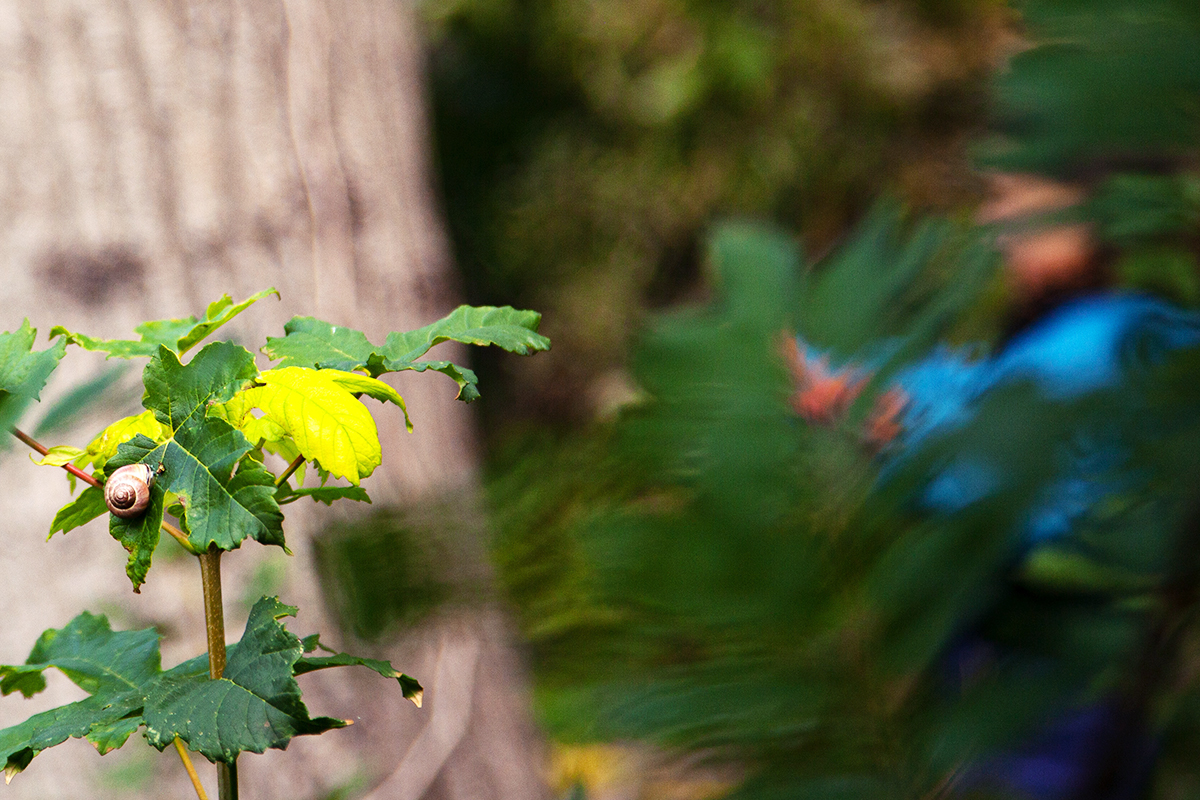
Cultivating Connection, Cultivating with Care (c) Lorene Blanche, 2022
Eine lebende Szenografie
Botanische Praxis als Design Methode
Floating Gardens erkundet und pflegt ökologische Koexistenz im urbanen Raum durch experimentelle Bepflanzungen, die Vielfalt und Raum für Selbstregulierung bieten und dadurch Ernte- und Habitate für lokale Arten fördern. An diesem integrativen Ansatz orientiert sich die Serie von Gärten, deren Bepflanzungskonzepte sich aus der Beobachtung der Lebenszyklen des Ortes heraus entwickelten und dadurch die Beziehungen zwischen Pflanzen, Bestäubern, Menschen und Vögeln fördern. Die wachsende Szenografie definiert sich durch eine auf Zielspezies (Überblick Arten) ausgerichtete spontane Vegetation (regional), die zunehmend aus dem urbanen Umfeld verschwindet, ergänzt durch klimaresiliente Arten, die eine artenübergreifende Ernährungssouveränität fördern.
Jede Bepflanzung reagiert auf das standortspezifische Mikroklima, das durch intensive Sonnen- und Windexposition, ausgeprägte Tag-Nacht-Temperaturschwankungen sowie Hochwasser und Trockenzeiten geprägt ist. Das in-situ und ex-situ Saatgutarchiv (non-GMO) hält die Pflanzenauswahl lebendig und fördert die schrittweise Anpassung der saisonal fortlaufend ausgesäten Arten an den Standort.
2026
Anbau essbarer, artenübergreifender Commons zur Förderung biologischer Vielfalt (seit 2019)
Die aktuellen Bepflanzungen bauen auf den vorhergehenden Saisons auf. Das Greenhouse wird dabei seit 2021 nach wie vor als in situ Saatgutarchiv aktiviert. Im Tomatengarten auf der oberen Plattform wird eine Auswahl an alten Sorten kultiviert, deren Saatgut 2018 Kokopelli der Floating University geschenkt hat.
Floating Beans und Rose and Berry Grove erforschen urbane Ernährungssicherheit in Zeiten von versiegelten, kontaminierten, dehydrierten und humusarmen Böden. Sie verstehen die Essbare Stadt als Netzwerk von artenübergreifenden Permakulturen, deren Prototypen von öko-informierten Gärtner*innen im urbanen Raum multipliziert und gepflegt werden können und damit frei zugängliche Nahrungsquellen für Bestäuber, Menschen, Nagetiere und Vögel schaffen.
Floating Beans [Floating Bohnen]
Konzeptualisiert von Adriana Gahona, Aufbau und Pflege mit der Gardens Community
Seit fünf Jahren baut Floating Gardens eine Vielfalt an ausgewählten, alten Saatgutsorten an und vermehrt diese. Im Floating Saatgutarchiv hebt sich vor allem Bohnen- und Wildblumensaatgut vor. Seit mehreren Saisons vor Ort kultiviert, können wir ihr Wachstum und ihre Anpassungsfähigkeit an das Mikroklima beobachten. Als Grundnahrungsmittel nährt die Bohne auch die Böden, in denen sie wächst und passt sich leicht an ihre Umgebung an, eine Eigenschaft von großer Bedeutung in Zeiten des raschen Klimawandels. Die schwebenden Pflanzenkörbe Floating Beans wurden mit Bohnensaatgut vom Floating Saatgutarchiv bepflanzt und von den gebauten Strukturen der Floating University gehängt, wodurch sie bei Überschwemmungen keiner Kontaminierung ausgesetzt sind. Ausgewählte Kräuter ergänzen die Bepflanzung. Die Körbe sind aus abbaubaren Materialen geflochten und können wiederverwendet, recycelt und kompostiert werden.
Rose and Berry Grove [Rosen- und Beerenhain]
Konzeptualisiert von Lorene Blanche, Bepflanzung und Beetpflege mit der Gardens Gemeinschaft
Vor dem Aufkommen der industrialisierten Landwirtschaft waren Beeren und Hagebutten ein wichtiger Nahrungszusatz, der schnelle Energie, Vitamine und Nährstoffe lieferte. Als essbare Allmenden wurden sie lokal gesammelt oder angebaut, idealerweise frisch gepflückt und direkt verzehrt sowie häufig getrocknet oder eingemacht und für lange Winter konserviert. Der im Küchengarten wachsende und sowohl von Menschen, als auch von Bestäubern und Vögeln regelmäßig aufgesuchte Rose and Berry Grove [Rosen- und Beerenhain] nimmt diese historische Rolle auf, indem sie diese Früchte als zugängliche, gemeinschaftliche interspezies Nahrungsquelle in die urbane Landschaft einfügt. Zur Stärkung bestehender ökologischer Beziehungen am Standort orientieren sich die gepflanzten Arten an den Beeren- und Rosenbüschen, die auf dem unzugänglichen Gelände rund um das Becken wachsen. Gezielt ausgewählte Wildblumen bieten Nahrung und Lebensraum für bestimmte Bestäuberarten.
Kooperationen
Floating Gardens Berlin ist seit 2025 in der deutschlandweiten Urbanen Gartenkarte des Netzwerks Urbane Geimeinschafsgärten gelistet (Anstiftung).
Floating Gardens pflegt einen kollaborativen Ansatz und Synergien mit Floating Programmen durch Aktivierungen wie Floating KidsUni (seit 2018), Open Soil Day #01 (2022), Nachbarschaftswochen(ende) (NN: Büro für Nachbarschaftliche Netzwerke), und Climate Care (2023).
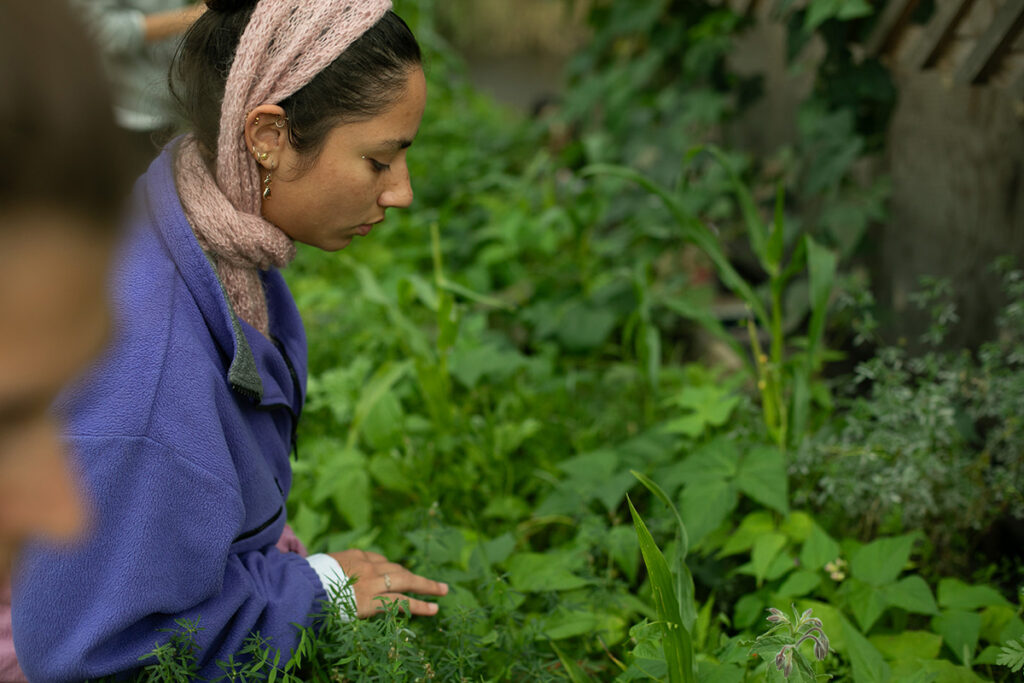
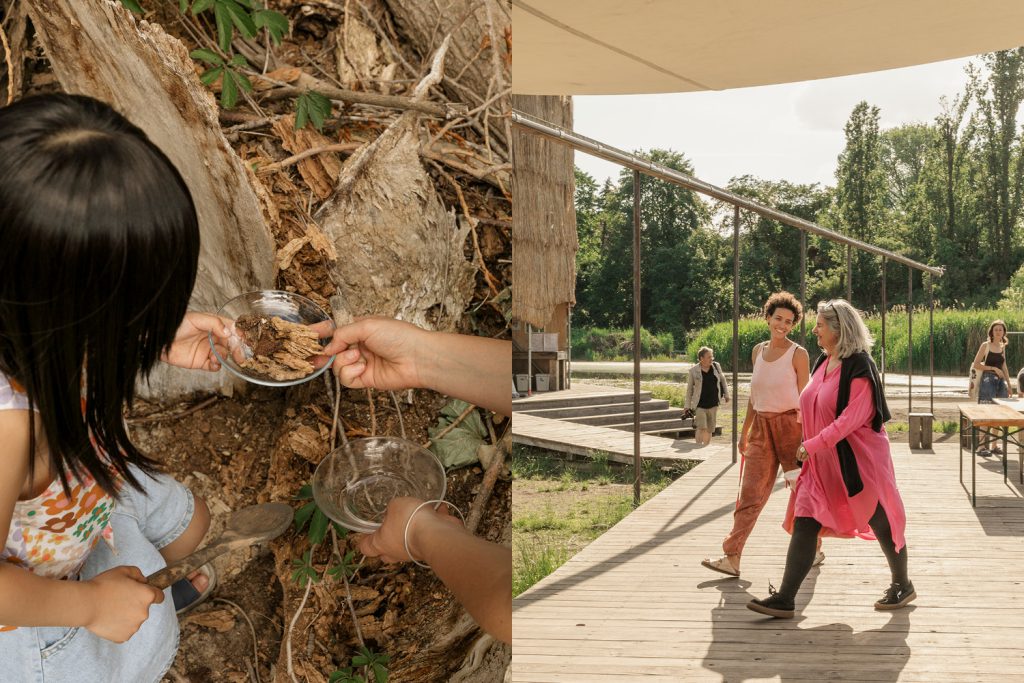
Open Soil Day #1
Floating Gardens bietet Raum für Projekte externer Kollektive und Initiativen wie kêmi ateliers Färbergarten und pflanzengefärbte Textilnstallation im Rahmen des Floating Programms Sowing Days (2023), und den Pollinator Pathmaker mit dem Museum für Naturkunde Berlin (seit 2023).
Floating Gardens trägt seine Praxis durch Kooperationen mit Kulturprogrammen und Bildungseinrichtungen über den Standort hinaus, darunter den Kultursommer Berlin: Tag des Überfluss, Tag der Frösche (2022) und Gartenworkshops für die Volkshochschule Kreuzberg-Friedrichshain (seit 2025).
Vergangene Programme
2024 Species in partnership, food for all [Nahrung für alle: Arten im Miteinander]
2023 Gartengemeinschaften als Grüne Infrastruktur
2022 [Was schwirrt in der Luft? Vom Leben vor Ort lernen] What’s in the air? Learning from the Life on Site
2021 Sowing and Growing: Vegetable Mix [Aussaat und Kultivierung: Gemüse Mix]
2020 Greening the Floating Iceberg [Grüner Eisberg]
2019 informelle Findung der Gartengemeinschaft
Team
Gardens Community Teilnehmende seit 2019 all mögliches Wildkraut, Katherine Ball, Bohnen, Bienen, Lorene Blanche, Calendula, Elisa Crocs, Jade Dreyfuss, frischer Kompost, Adriana Gahona, Hannah Greven, Pia Groleger, Valentin Hammoudi, Laureen Hünig, Libellen, Erdbeeren, Ipomea, Gilly Karjevsky, Stefan Klopfer, Salome Kofler, kêmi atelier, Klee, Martina Kolarek, Krähen, Bejal Lewis, Ute Lindenbeck, Marienkäfer, Matsch, Jann Mausen, Mehlschwalben, Moskitos, Nachtmotten, Lena Nahrwold, Nils Palme, Nina Peters, Regenwasser, Ru, Antonia Schlaich, Schnecken, Antonin Steinke, Schmetterlinge, Sophia Tabatadze, Lara Tonon, Karin Weissenbrunner, Wildrosen, Andrew Wu, Sarah Yaparsidi, zahlreiche gelegentliche Teilnehmer:innen.
Programmleitung: Adriana Gahona, Lorene Blanche
Beetpflege: Gardens Community
Texte: Lorene Blanche
Text Floating Beans: Adriana Gahona
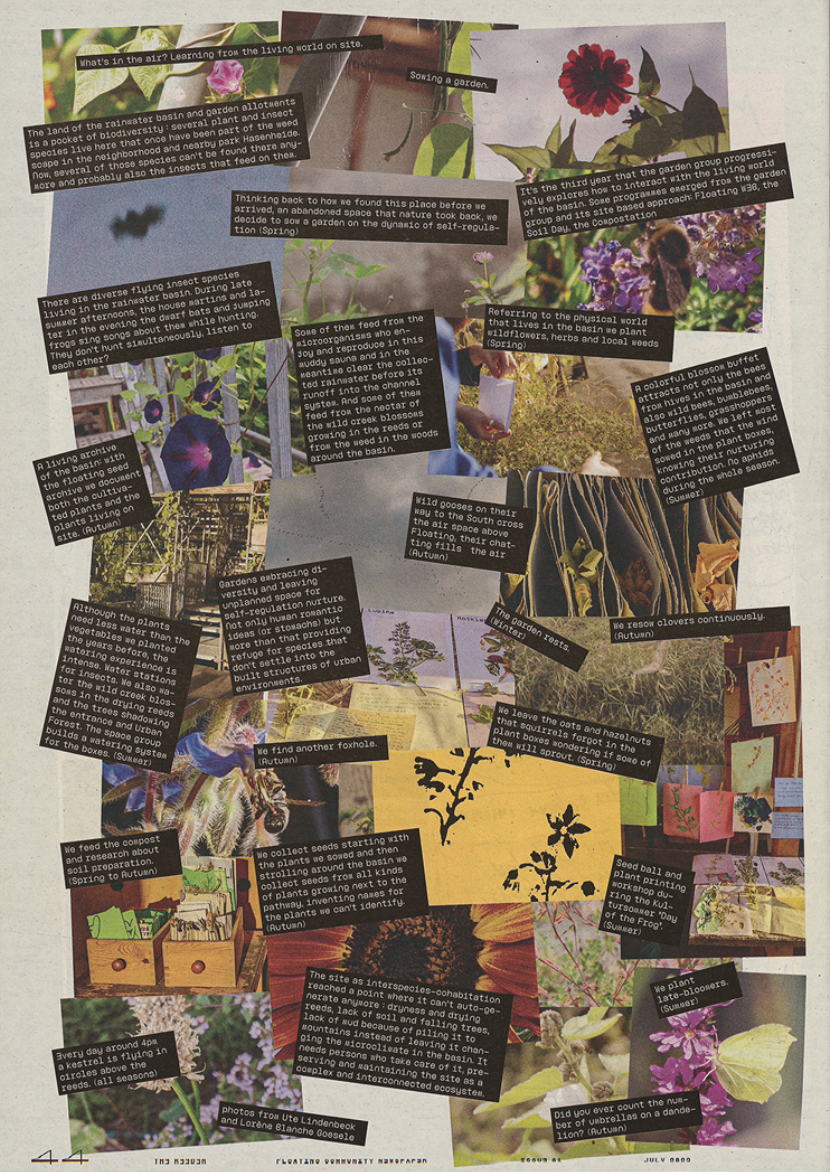
Repositorium
❋
Floating Beans & Rose and Berry Grove werden durch die großzügige finanzielle Unterstützung von Anstiftung für die Bereitstellung der Materialien ermöglicht (2026).
Floating Gardens wurde in den Jahren 2023 und 2024 von der Senatsverwaltung für Kultur und Europa unterstützt.
Seit 2018 unterstützt Kokopelli mit großzügigen Saatgutspenden.