Floating Gardens
Cultivate with Care: collective botanical practice for biodiverse regeneration
Floating Gardens is a volunteer-based, intercultural, transdisciplinary, and women-led Garden Community that explores how self-organised garden Commons contribute to reimagining and re-creating ways of eco-coexistence in urban space. The planted interspecies permacultures connect some of Floating University’s built structures with the basin’s plantscape and pollinator life while growing a community of creative, terrain-trained biodiversity caretakers.
Since 2019, the Gardens community has met weekly for collective Cultivate with Care sessions from April to November. Together, the participants cultivate a space for botanical practice that reconnects with the living world through place-making, knowledge exchange, and applied reciprocity. What began as a group of leisure gardeners continues to evolve into a socio-ecological infrastructure for collective learning about low-tech biodiverse regeneration practices.
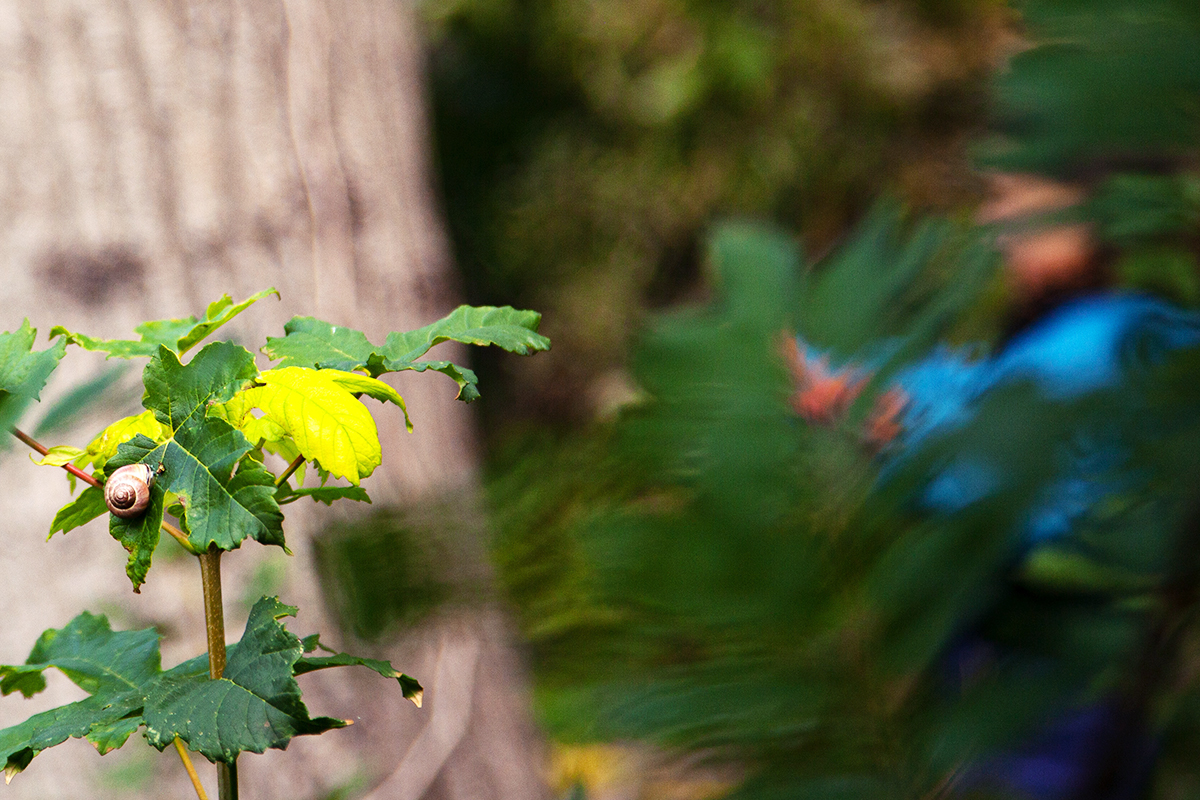
Cultivate with Care Session (c) Lorene Blanche, 2022
Cultivating a Living Scenography
Botanical practice as design method
Floating Gardens is a series of experimental plantings that fosters diversity, creates room for self-regulation, and therefore supports habitats and food sources for endangered species. Their cultivation is guided by a local flower scape that feeds insects yet increasingly vanishes from public space (overview of species), combined with climate-resilient plants that support interspecies food sovereignty; and an experimental approach to ecological coexistence through planting.
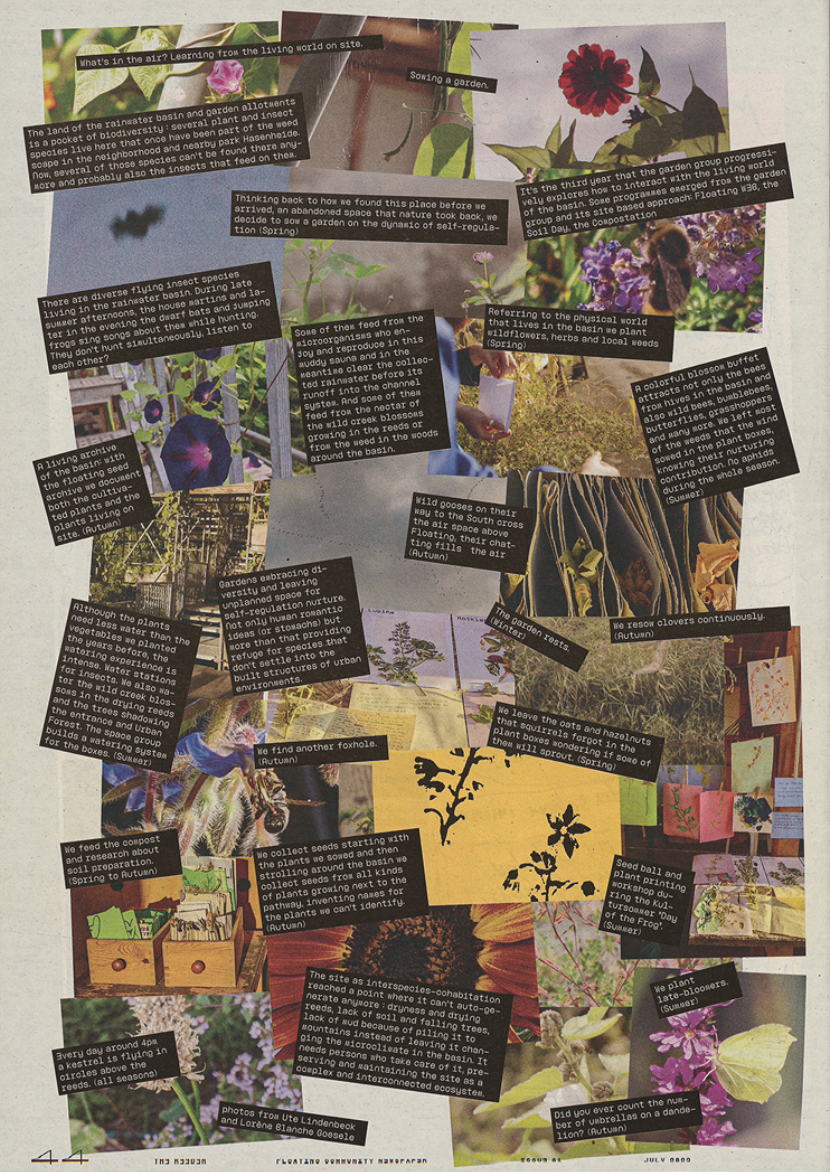
The plantings evolved through close observation of the site’s ecological cycles, fostering relationships between plants, pollinators, birds, and people. Each Garden features its own planting concept while responding to the site’s microclimate, which is characterized by intense solar and wind exposure, pronounced day-night temperature fluctuations, floods, and droughts. The in-situ and ex-situ Seed Archive keeps alive the plant selection and fosters the gradual adaptation of seasonally replanted species to the site’s demanding environmental conditions.
2026
Planting edible interspecies Commons for biodiverse regeneration since 2019
Current plantings build on previous seasons. The Greenhouse is activated as an in-situ seed archive (since 2021). The Tomato Garden on the upper platform cultivates a variety of non-GMO seeds gifted by Kokopelli in 2018.
Floating Beans and Rose and Berry Grove explore urban food sovereignty in the face of sealed, contaminated, dehydrated, and topsoil-depleted soils. They envision the edible city as a network of interspecies permacultures: prototypes that can be replicated and maintained by eco-informed gardeners throughout the urban landscape, creating freely accessible food sources for humans, pollinators, birds, and rodents.
Floating Beans
Conceived by Adriana Gahona, installed and cared for with the Gardens Community
For the past five years, Floating Gardens has cultivated and propagated a diverse selection of carefully chosen heirloom seed varieties. The Floating Seed Archive is particularly rich in local spontaneous flowers and beans. Beans have been grown over multiple seasons, allowing us to study their growth and adaptation on site. As a staple crop, beans enrich the soil in which they grow through nitrogen fixation and readily adapt to local conditions: an ability of increasing importance in times of rapid climate change. The Floating Beans, planted with bean seeds collected and reproduced in-situ over the years, are suspended from the structures of Floating University, protecting them from contamination during periods of flooding. Selected herbs complement the planting. Made from biodegradable materials, the woven planter baskets can be reused, recycled, and ultimately composted.
Rose and Berry Grove
Conceived by Lorene Blanche, planted and cared for with the Gardens Community
Before the advent of industrial agriculture, berries and rose hips were part of the local edible Commons: growing spontaneously and accessible to communities, they were also cultivated locally and consumed fresh in season. Surplus harvests were often dried or preserved to sustain communities through the winter months. They provided an important accessible seasonal food source to both human and animal communities, supplying energy, vitamins, and nutrients.
Growing in the kitchen garden that is also frequently visited by pollinators and birds, Rose and Berry Grove revisits this historical role by reintroducing these resilient shrubs into the urban landscape as an accessible, interspecies food source. The grove draws on the same species of berry bushes and wild roses that already grow spontaneously on the inaccessible terrain surrounding the basin, reinforcing existing ecological relationships within the site. Selected spontaneous flowers provide forage and habitat for target pollinator species.
Cooperations
Floating Gardens Berlin have been listed on the Urban Gardening Map of the Network of Urban Community Gardens (Anstiftung) since 2025.
Floating Gardens embraces synergies with Floating Programmes through activations by Floating KidsUni (since 2018), Open Soil Day #01 (2022), Neighbourhood Week(end)s (Office NN for Neighbourhood Networks), and Climate Care (2023).
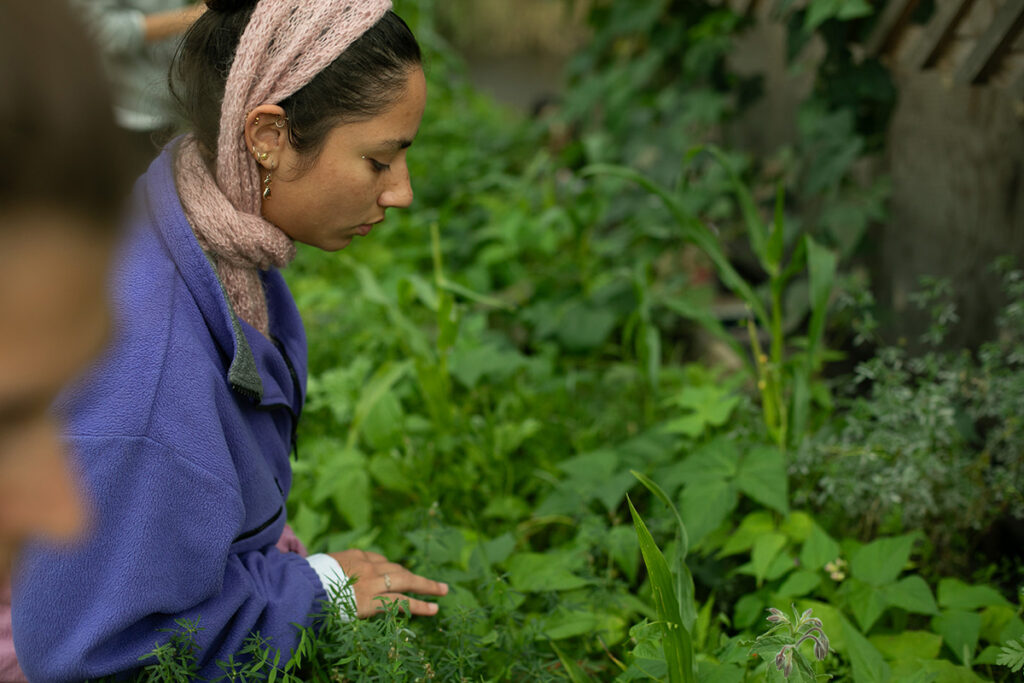
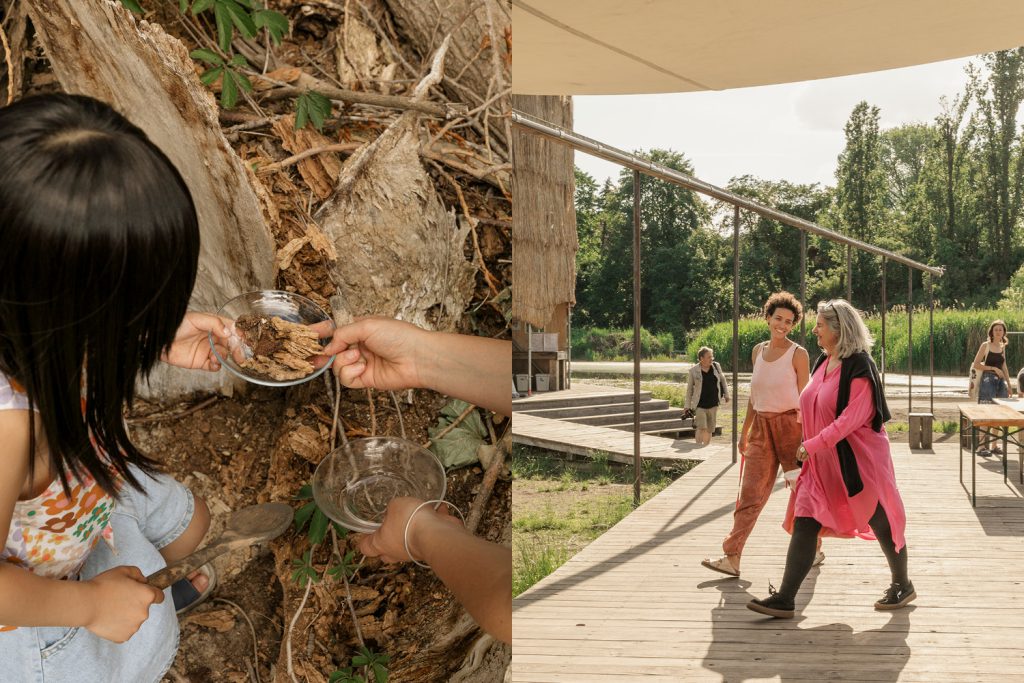
Open Soil Day #1
Floating Gardens hosts collectives and initiatives, such as kêmi atelier’s Coloring Garden and a plant dyed fabric installation in frame of the Floating programme Sowing Days (2023); and Pollinator Pathmaker with Museum für Naturkunde Berlin (since 2023).
Floating Gardens extends its practice beyond the site through cooperations with cultural programmes and educational institutions, including Kultursommer Berlin: Day of Waste, Day of the Frogs (2022); gardening workshops for Volkshochschule Kreuzberg-Friedrichshain (since 2025); and lectures/panel talks.
Past Programmes
2024 Species in Partnership, Food for All
2023 Garden Communities as Green Infrastructures
2022 What’s in the air? Learning from the Life on Site
2021 Sow and Grow: Vegetable Mix
2020 Greening the Floating Iceberg
2019 informal founding of the garden community
Team
Gardens community participants since 2019 all kinds of weeds, Katherine Ball, beans, bees, Lorene Blanche, butterflies, calendula, clover, Elisa Crocs, crows, dirt, Jade Dreyfuss, fresh compost, fireflies, Adriana Gahona, Hannah Greven, Pia Groleger, Valentin Hammoudi, house martins, Laureen Hünig, ipomea, Gilly Karjevsky, Stefan Klopfer, Salome Kofler, kêmi atelier, Martina Kolarek, ladybugs, Bejal Lewis, Ute Lindenbeck, marigolds, Jann Mausen, mosquitoes, Lena Nahrwold, night moths, Nils Palme, Nina Peters, rainwater, Ru, Antonia Schlaich, snails, Antonin Steinke, strawberries, Sophia Tabatadze, Lara Tonon, Karin Weissenbrunner, wild roses, Andrew Wu, Sarah Yaparsidi, and many occasional participants.
Programme Coordinators: Adriana Gahona, Lorene Blanche
Plant bed care: Gardens Community
Texts: Lorene Blanche
Text Floating Beans: Adriana Gahona
Repository
❋
Floating Beans as well as Rose and Berry Grove are made possible through the generous financial support for materials provided by Anstiftung (2026).
Floating Gardens has been supported by the Senatsverwaltung für Kultur und Europa in 2023 and 2024.
Since 2018, Kokopelli: Organic, Open-Pollinated, and Heirloom Seeds has supported Floating Gardens with generous crop seed gifts.