


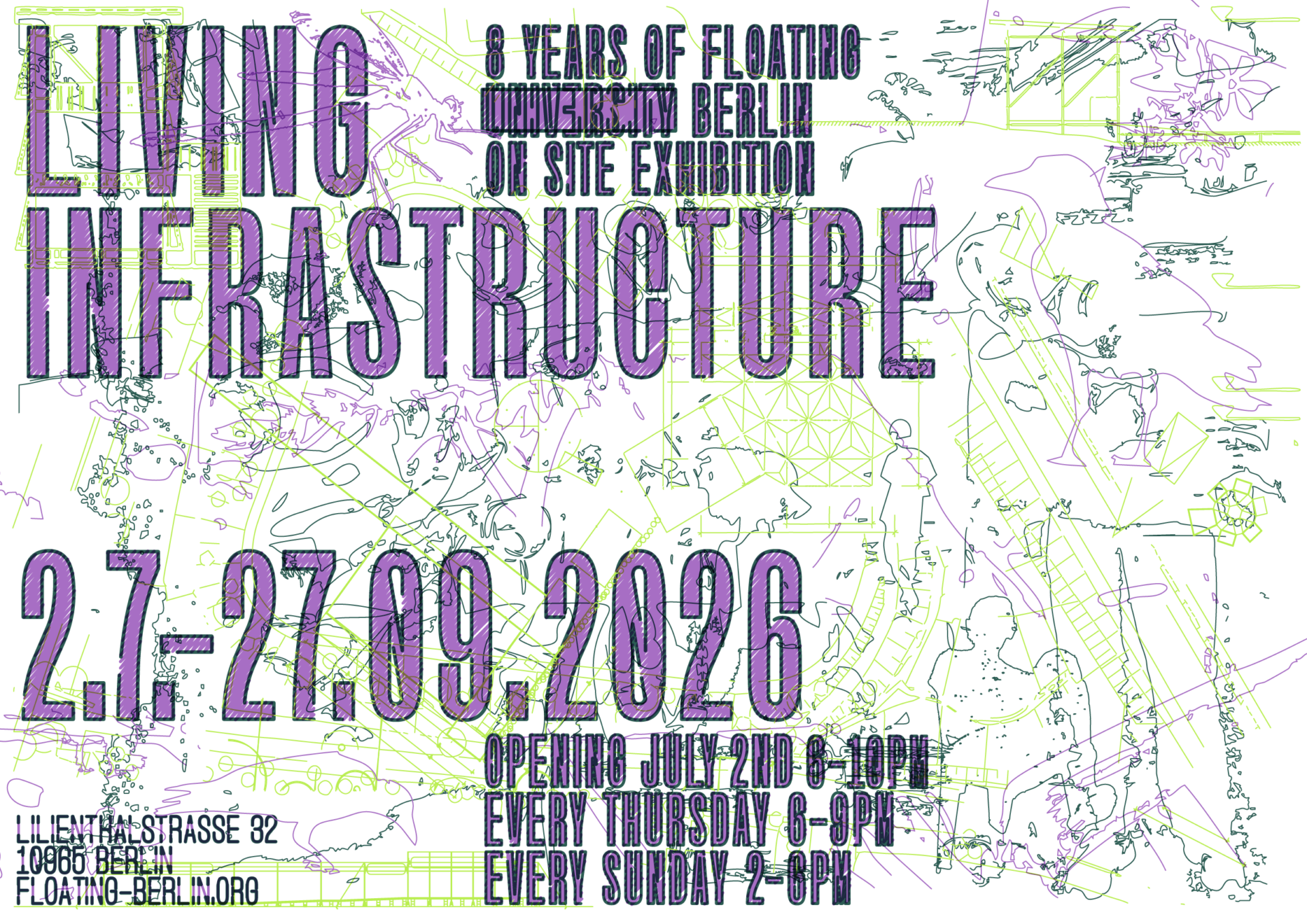
Floating e.V. opens LIVING INFRASTRUCTURE – an on-site exhibition celebrating eight years of experimental learning and cohabitation with the rainwater basin in Kreuzberg. Open throughout the summer, the exhibition unfolds the transformation of a technical rainwater infrastructure into an ongoing eco-social experiment in multi-species living.
Join us on July 2 for the opening with guided tours in German and English, shared food, an immersive audio walk and an outdoor film screening.
Programme
6:00pm: Welcome by Floating e.V.
6:30pm: Guided tours (German & English)
7:30pm: Snacks and drinks
Free admission
Living Infrastructure
8 Years Floating University
Floating University celebrates eight years of being with the Tempelhof rainwater retention basin. This exhibition follows the transformation of a technical rainwater infrastructure into an ongoing eco-social experiment in multi-species living.
Floating forms part of the site’s and the basin’s meandering, messy and polyvocal history. It extends across more than 100 years and has involved a myriad of people, animals, social norms and legal apparatus: engineers, city administrators, management companies, bureaucrats, community gardeners, an architecture collective, inhabitants of Berlin, over sixty members of a care-taking association, students from various universities, children from schools across the city, theorists and practitioners, artists and scientists; but also contracts, building permits, lobby work, maintenance protocols; gates and fences, doors and scaffolds, screws and wooden planks; wetland flora, trees, insects, birds and mammals, polluted waters, compost, and and so much more. In other words, an urban feral wetland.
Like many infrastructural facilities, the basin was built as a monofunctional entity: planned during the nazi regime, maintained by specialists and largely inaccessible despite being publicly owned. In 2018, raumlabor berlin opened this infrastructural site as an experimental learning environment for urban practice, temporarily activating a place that had long remained enclosed. Since 2019, Floating e.V., a not-for-profit association, has continued this work through a long-term relationship with the site.
Rather than acting as tenants, Floating e.V. instigates the figure of the steward: a self-organised group that tends an urban water body and its complex ecosystem while opening it as a shared space for encounter. Stewardship is an ongoing practice of care, repair, maintenance and negotiation. It means remaining with the site and assuming responsibility for the many conditions that allow its multiple forms of life: maintaining and adapting spatial structures, supporting the ecosystem that has taken root and continues to thrive, opening and hosting different groups, carrying out the institutional and political work required to secure its future, and continuously fundraising to sustain these efforts. Stewardship therefore becomes a holistic urban practice that attends to ecological processes, social life, governance structures and material maintenance as inseparable concerns.
Looking forward, our vision is not to resolve these conditions into a single identity but to preserve and nurture their coexistence. The future of the basin lies in strengthening its hybridity: ensuring that it remains operational as water infrastructure while continuing to host ecological succession, collective use, cultural production and forms of shared responsibility that exceed conventional models of tenancy, management or public space.
Floating e.V. is Adriana Gahona, Alexis de Raphelis, Andrea Hofmann, Andrew Wu, Anna Kokalanova, Benjamin Foerster-Baldenius, Benjamin Frick, Benoît Verjat, Berit Fischer, Camilla Bausch, Carla Kienz, Carmen Carolina Staiano Christof Mayer, Coco Wiss, David Morsi, Dorothee Halbrock, Eliza Chojnacka, Erika Mayr, Felix Wierschbitzki, Florian Foerster, Florian Kurzenberger, Florian Stirnemann, Franzisko Matthis, Garance Maurer, Gilly Karjevsky, Gülsüm Güler, Hannah Lu Verse, Inci Güler, Jade Dreyfuss, Jeanne Astrup-Chauvaux, Joanne Pouzenc, Jöran Mandik, Katherine Ball, Katja Szymczak, Kristin Lazarova, Laura Raber, Leonard Struebin, Lena Düspohl, Lisa van Heyden, Lorene Blanche Goesele, Lorenz Kuschnig Leford, Maddalena Pornaro, Mark Schmidt, Markus Bader, Martin Kaltwasser ✝, Martina Kolarek, Mauricio Corbalan, Nina Peters, Orlan Angeli, Raul Walch, Roman Karrer, Ronja Schratzenstaller, Rosario Talevi, Sabine Zahn, Sarah Bovelett, Serena Abbondanza, Sophia Tabatadze, Stefan Klopfer, Stefan Kreft, Silja Teresa Huppertz, Ute Lindenbeck.
Living Infrastructure
8 Years Floating University
Credits
Curators: Carmen Carolina Staiano, Jeanne Astrup-Chauvaux
Texts: Rosario Talevi
Text Floating Gardens: Lorene Blanche Goesele
Copy-Editing: Jeanne Astrup-Chauvaux, David Nil Morsi, Ute Lindenbeck
Translation: David Nil Morsi
Graphic Design: Roman Karrer
Communication: Lisa van Heyden
Audio Archive: Hannah Lu Verse with Floating e.V.
Architecture: Lorenz Kuschnig, Florian Stirnemann, Felix Wierschbitzki
Gardens: Adriana Gahona, Lorene Blanche Goesele and Gardens community
Images: Lena Giovannazzi, Alexander Stumm, Victoria Tomaschko, Mor Akadir, Pierre Adenis, Katharina Geist, Sebastian Díaz de León, Constanze Flamme, Daniel Seiffert, Lorenz Kuschnig, David Nil Morsi, Rosario Talevi, Garance Maurer, Silja Teresa Huppertz, Lorene Blanche Goesele and other members of Floating. e.V.

