


Floating Apéro
Politics in the basin
(c) David Nil Morsi
(c) David Nil Morsi
(c) David Nil Morsi
(c) David Nil Morsi
(c) David Nil Morsi
(c) David Nil Morsi
(c) David Nil Morsi
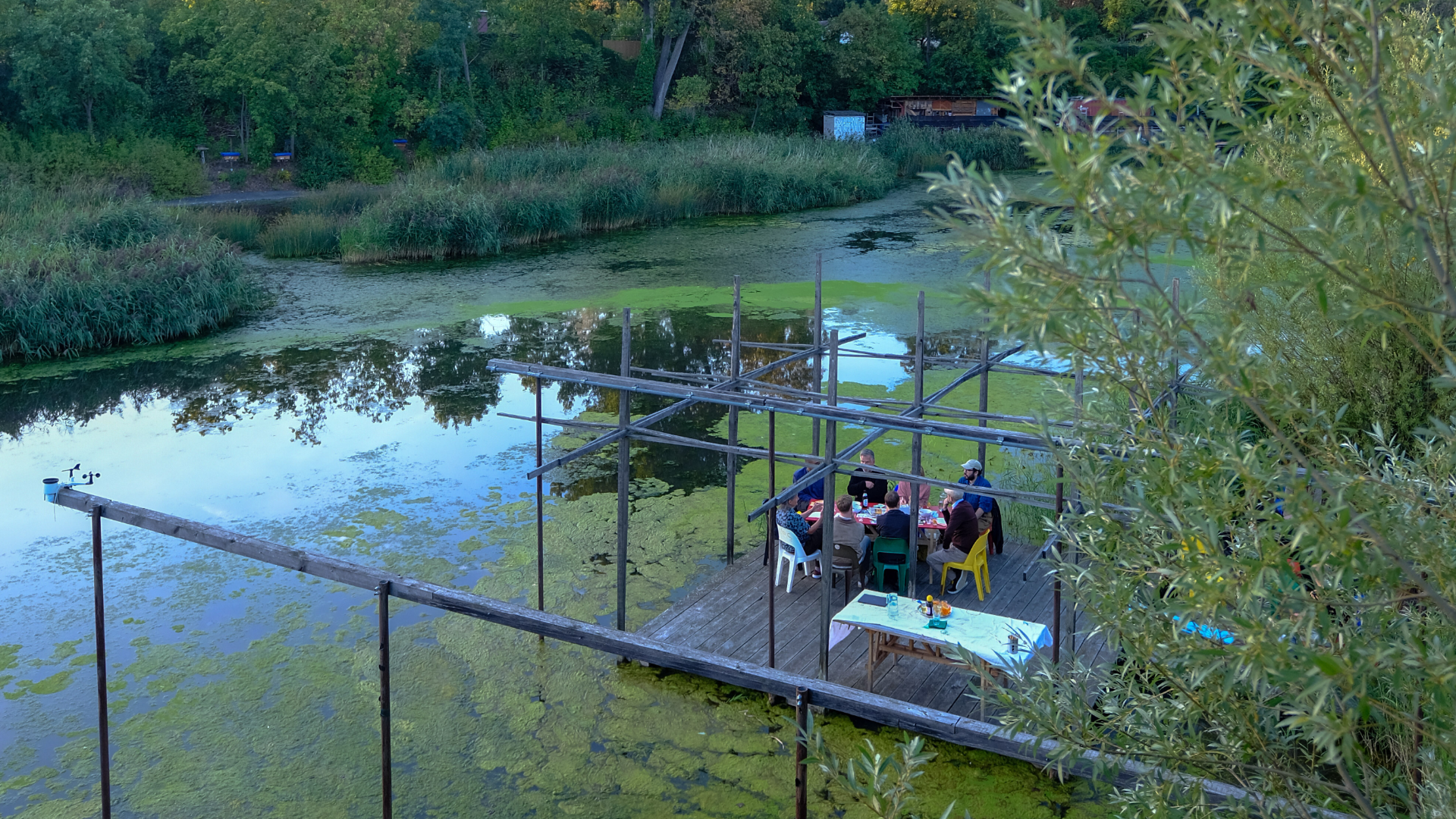
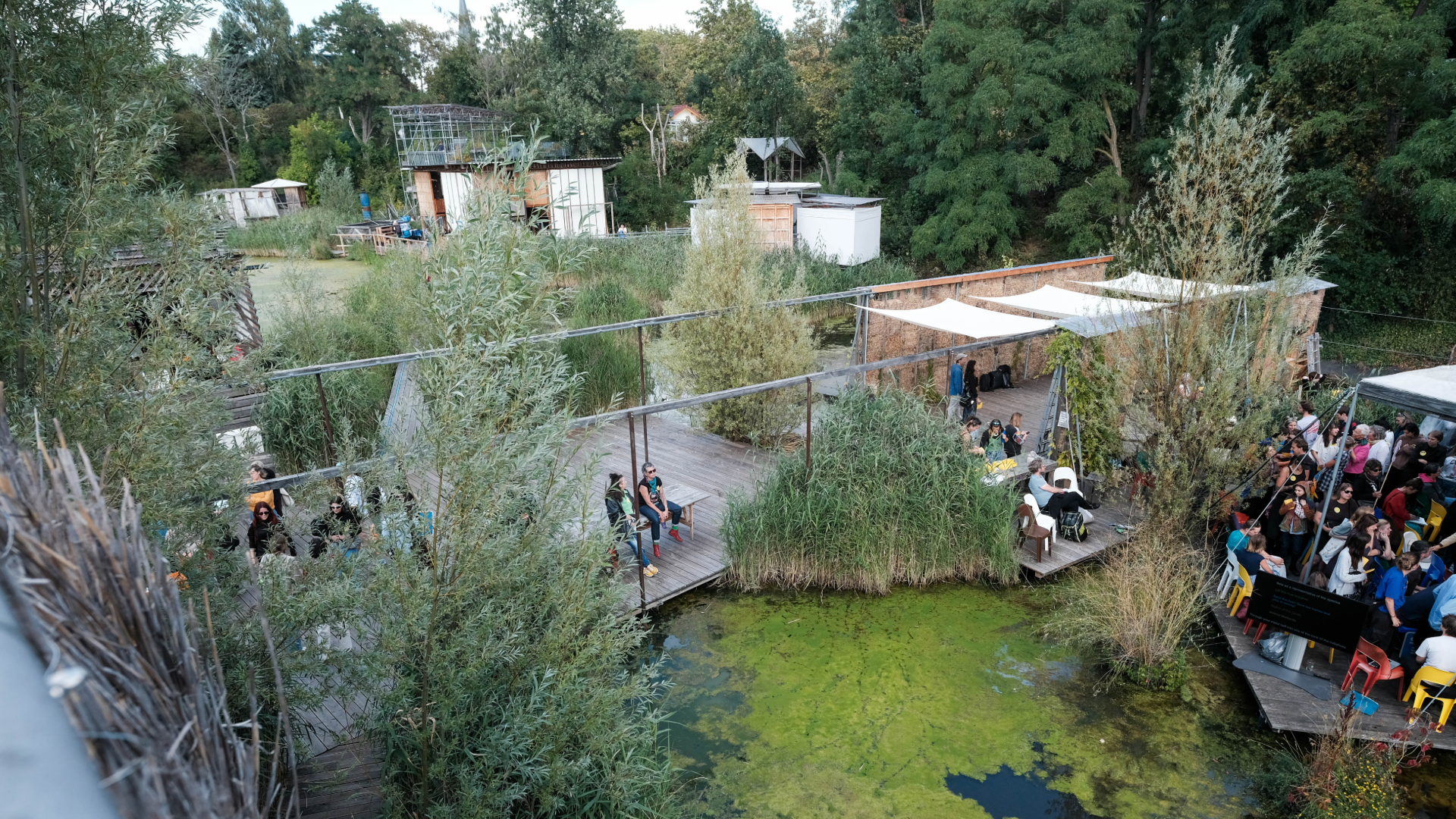
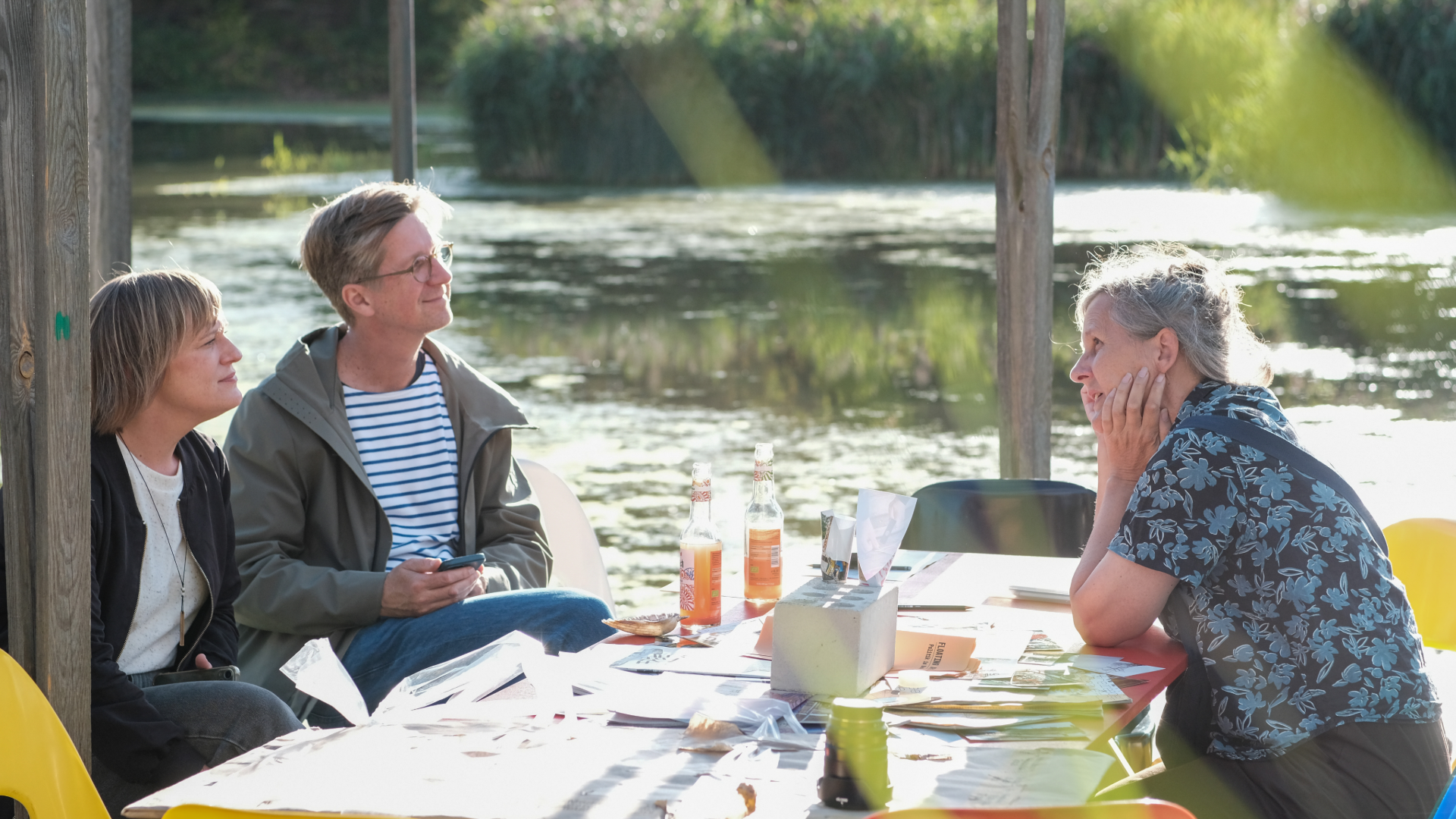
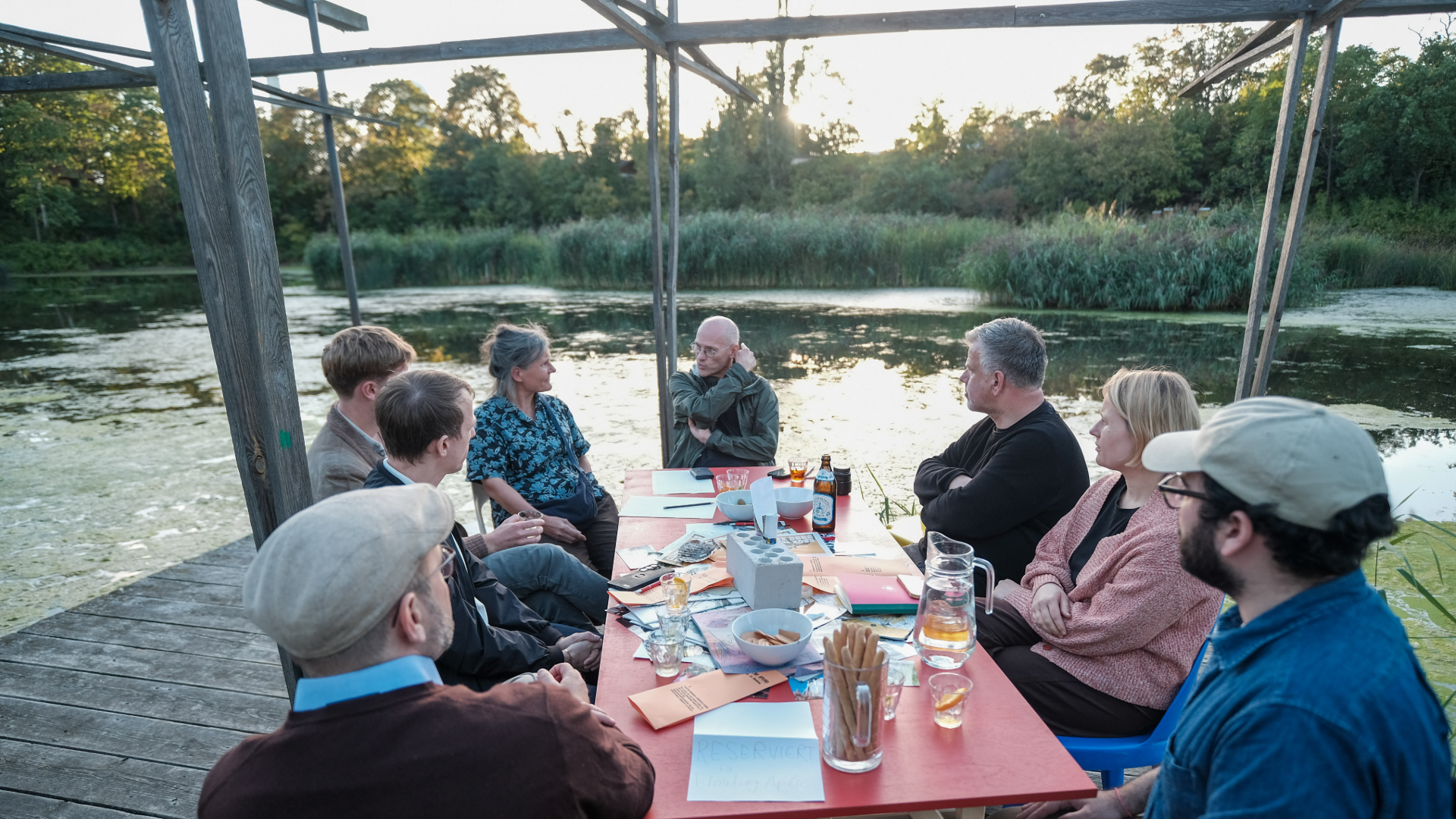
On September 6, we invited political parties from district and state legislatures in the rainwater-retention-basin Kreuzberg and held a constructive discussion about the future of the natureculture-project and related urban policy issues. Below, you’ll find the parties’ positions on the future of Floating University and their detailed responses to questions regarding climate adaptation, hybrid infrastructures, and urban development focused on the public good.
In attendance were:
Katrin Schmidberger, Bündnis 90 / DIE GRÜNEN Berlin
MdA and direct candidate for the House of Representatives, Friedrichshain-Kreuzberg 2
Pascal Striebel, Bündnis 90 / DIE GRÜNEN Berlin
BVV Friedrichshain-Kreuzberg, parliamentary group spokesperson
Michael Efler, DIE LINKE Berlin
MdA and direct candidate for the House of Representatives, Friedrichshain-Kreuzberg 2
Britt Schlünz, SPD Berlin
Direct candidate for the House of Representatives, Friedrichshain-Kreuzberg 2
Andy Hehmke, SPD Berlin
District councilor for schools, sports, and facility management Friedrichshain-Kreuzberg
Jakob Welker, VOLT Berlin
Direct candidate for the House of Representatives, Friedrichshain-Kreuzberg 2
Rafael Kaaz, VOLT Berlin
Candidate for the House of Representatives
Jörg Höhn, FDP Berlin
Direct candidate for the House of Representatives, Friedrichshain-Kreuzberg 1
Andy Hehmke, in his capacity as the current district councilor for schools, sports, and facility management, answers our questions in accordance with the responsibilities associated with this position. That’s why we collected his answers in an own section here.
*Representatives from all democratic parties were invited. No one from the CDU was able to attend the Floating Apéro.
The Floating Apéro event was organized and moderated by David Nil Morsi and Ute Lindenbeck.
1 Ensuring the Long-Term Viability of Floating University
What specific steps are you taking to ensure the long-term future of Floating University and to keep the rainwater retention basin open to the public?
Bündnis 90 / DIE GRÜNEN Berlin
We want to preserve Floating University in the long term and create a legally secure future for this natural, cultural, and educational site. The initiative’s long-standing commitment has transformed a technical stormwater retention basin into a special place for urban nature, learning, and community. Now the goal is to build on the experiences of the past eight years and turn this temporary use into a permanent solution. Of course, the outstanding issues regarding building codes and nature conservation must be resolved in collaboration with all stakeholders, and the site’s valuable status as a biotope must be preserved.
DIE LINKE Berlin
The Left advocates for an urban development policy that is shaped in collaboration with Berliners and civil society. Places like Floating University are important spaces for experimentation in cultural participation, education, ecology, and civic engagement. We are specifically committed to ensuring the long-term preservation of such public-interest-oriented spaces and initiatives. We therefore intend to establish budget lines with clear earmarking for civil society-led urban development projects. We will permanently secure land for public-interest uses.
SPD Berlin
As long as the stormwater retention basin continues to serve its technical purpose, repurposing it is virtually impossible. In the coming legislative session, I therefore do not expect any final decisions regarding the site. It therefore makes sense to actively use the time until then to advance the “Floating” concept. The idea of converting the basin into an infiltration area would support the goal of a climate-resilient “sponge city.” I oppose residential construction on this site.
VOLT Berlin
Volt aims to replace the current uncertain and short-term project-based approach with long-term structural funding and long-term usage agreements. In addition, we plan to hire funding advisors to help nonprofit organizations and initiatives apply for grants from various sources.
FDP Berlin
We want to preserve Floating University as a civil society-led space for learning and experimentation and secure its legal and planning status, without creating new blanket bans on use or rigid quotas.
• The State of Berlin (SenSBW) and Berliner Wasserbetriebe, as the owners, should work together with the the district of Friedrichshain-Kreuzberg, examine a long-term usage agreement ideally through a transparent, time-limited special-use or hereditary building rights model that provides the initiative with planning certainty without abandoning the principle of flexible allocations.
• The basin plays an important role in the urban climate (evaporation, effect of unsealing). We oppose permanent sealing or overbuilding; at the same time, we want to clearly regulate agreed-upon, compatible public programs (education, culture, research) as special uses, rather than leaving them in a gray area.
• Instead of permanent subsidies, we rely on project-based funding, partnerships with universities, foundations, and private-sector sponsorship that aligns with our mission and does not jeopardize the nonprofit status of Floating e.V. – supplemented by unbureaucratic special-use spaces for cultural and educational projects. A long-term arrangement within the framework of the Tempelhof Airport project company is also conceivable.
2 Multiple uses for urban spaces
How do you plan to facilitate the multiple uses of urban spaces and infrastructure for the environment, culture, education, and the common good ?
Bündnis 90 / DIE GRÜNEN Berlin
In a densely built-up district, we can afford less and less to use spaces for a single purpose. We are therefore seeking solutions that combine climate protection and climate adaptation with spaces for culture, social interaction, and community. Our pedestrian zones and school zones are examples of this. There, space is created for play and social interaction. At the same time, space is provided for safe mobility on foot and by bike, and areas are de-paved and greened.
The Floating University project demonstrates in a very special way how technical water infrastructure can simultaneously serve as a natural, educational, and cultural space. We want to continue promoting such multiple uses.
DIE LINKE Berlin
Mixed-use development helps prevent further land consumption in Berlin. We want to facilitate the mixed use of spaces so that services can be integrated, synergies fostered, and spaces utilized more effectively.
To this end, we want to launch pilot projects, for example, to create care centers designed to fill gaps in care services, provide people in the neighborhood with access to and space for collaborative care work and self-organization, and serve as venues for art, culture, health, and other public-interest purposes. We want to publicly promote the development of such places and ensure their use through reliable agreements between civil society and the public sector. In this way, with relatively little effort, we will create a social and ecological infrastructure that is relevant to everyday life, affordable, resource-efficient, and resilient to crises.
SPD Berlin
In a densely developed district like Friedrichshain-Kreuzberg, there is hardly any space without competing land-use interests; participatory processes would need to take this into account. I am committed to actively promoting temporary uses and simplifying the permitting process for them. Floating University demonstrates how successful mixed-use can work in the areas of ecology, education, and culture.
VOLT Berlin
We are launching a comprehensive initiative to reduce sealed surfaces and store rainwater where it falls—on green roofs, in public squares, schoolyards, and in retention basins. In doing so, we make multiple uses of these areas: as recreational spaces, green spaces, water reservoirs, and protection against heavy rainfall. In addition, we support neighborhood projects, restore floodplains, and modernize water infrastructure to stabilize groundwater levels, reduce heat, and secure drinking water supplies.
FDP Berlin
For us, multiple uses are a necessity driven by scarcity and innovation – especially in a densely populated district like Friedrichshain-Kreuzberg. We want to make this possible without further complicating planning procedures.
• We want to designate special-use areas for culture, education, and public-interest projects in a less bureaucratic manner and facilitate the use of designated outdoor spaces. For concrete, pragmatic decision-making regarding the affected areas, we propose an on-site meeting of the BVV or the relevant committees.
• A vacant-lot registry and systematic documentation of interim uses help to temporarily open up spaces for ecological, cultural, and educational purposes
• Greater digitization, clear lines of responsibility and deemed approvals when deadlines are missed make multiple uses practical in everyday life.
• We prefer flexible, transparent procedures that, depending on the location, reward the best overall concept (including ecology, culture, and the public good) without categorically excluding investors.
3 Berlin as sponge city
How will you drive Berlin’s climate-resilient transformation into a “sponge city” while rethinking existing water infrastructure ?
Bündnis 90 / DIE GRÜNEN Berlin
Berlin must view rainwater more as a resource: It should be retained, used, and allowed to infiltrate as much as possible where it falls. To this end, we are working on many small and large adjustments: In Xhain, we have already unsealed or made over 14,500 m² of land more permeable during the current legislative term. Tree pits are increasingly being converted into “green drains” so that more rainwater can infiltrate the ground and relieve pressure on the sewage system during heavy rainfall events. As a side benefit, this protects street trees by giving their roots more space. Another project currently in the planning stages is the construction of a cistern to irrigate the cemeteries on Bergmannstraße. The cistern would collect all the rainwater from an 11-hectare property.
DIE LINKE Berlin
Berlin is to be transformed into a “sponge city” through soil unsealing, stormwater management, and the expansion and maintenance of natural areas, so that we are better protected against the consequences of the climate crisis. By 2030, we will achieve net-zero soil sealing. Wherever soil is sealed within Berlin, an equivalent area must be unsealed. We intend to expand rainwater management through on-site infiltration, including on existing properties, for later use. The Berlin Rainwater Agency, as the central advisory body for the transition to a “sponge city,” will be better equipped to fulfill its responsibilities. We aim to promote water conservation and the increased use of graywater through legislative measures. We will make it easier to install rain barrels in public spaces, thereby enabling citizens to support the transition to a “sponge city.”
SPD Berlin
Berlin will only become climate-resilient if we consistently allow rainwater to seep into the ground locally instead of directing it into the sewage system. Together with the Berlin Water Authority and the Rainwater Agency, we want to disconnect significantly more areas from the sewage system and make cross-property rainwater management legally binding.
VOLT Berlin
We want to consistently implement the “Trees Plus” Act, which I passed as part of the Baumentscheid / Tree Policy. Following the example of Paris and Amsterdam, we are creating more green spaces and unpaved areas that can also serve as schoolyards, playgrounds, community gathering places, and retention areas during heavy rainfall. In doing so, we are specifically supporting neighborhood projects that work together with local residents to enhance heat protection, biodiversity, and quality of life.
FDP Berlin
The FDP Berlin advocates for decentralized stormwater management and modern water infrastructure rather than pure centralization:
• We want to establish green roofs and green facades, infiltration in courtyards, streets, and plazas, as well as the use of stormwater for watering trees and green spaces as the standard in new construction and the modernization of existing buildings, and provide targeted support for these measures.
• We want to designate pilot areas in which rainwater management is implemented in an exemplary manner—precisely where projects like the Floating University demonstrate what works.
• In addition to storage capacity within the sewer system, we rely on relief through infiltration and retention on-site to mitigate overloading during heavy rainfall.
• We aim to promptly implement the European Water Framework Directive, reduce wastewater discharges, and, where necessary, evaluate additional treatment stages (e.g., for pharmaceutical residues)—always in a technology-neutral and economically viable manner.
• A development plan for riverbanks and waterfront areas, public accessibility, and nature oriented design are integral parts of our “Sponge City” strategy.
4 Civil society as a partner
What role should civil society initiatives play in the future of Berlin’s urban development—and how do you intend to strengthen their long-term involvement?
Bündnis 90 / DIE GRÜNEN Berlin
Good urban development does not arise solely from government and politics. Civil society initiatives contribute expertise, ideas, networks, and practical experience. We want to involve them early on, take them seriously as partners, and provide them with reliable points of contact, including within the government. Our goal is to further accelerate and improve cooperation between different city departments. To this end, we have established structures in recent years that serve as intermediaries between civil society and the administration, such as the participatory structures in the area of urban development or the Coordination Office for Community Gardening. In addition, we strive to support civil society initiatives with small grants.
DIE LINKE Berlin
Open and inclusive of everyone, not behind closed doors; early on and with an open-ended approach—this is how we want to shape the socio-ecological urban transformation together with the people of Berlin. Residents know best how their city should develop. For us, the redistribution of decision-making power to Berliners is a crucial foundation for an empowering culture of participation, comprehensive transparency, and the political influence of civil society. We take the concerns of initiatives and engaged neighbors seriously and work with them to develop concepts for cooperative urban development.
Building on our experiences with the Haus der Statistik and the Kreuzberg City Hall Block (Dragoner-Areal), we aim to further institutionalize cooperative development between the State of Berlin, the districts, public-interest enterprises, and civil society organizations. We support spaces for solidarity, community, self-organization, and public-interest initiatives.
SPD Berlin
To ensure that this participation is not left to chance, we want to strengthen it structurally: for example, by expanding the “Mein Berlin” participation platform, focusing on on-site dialogues and early-stage information sessions for construction and infrastructure projects, and ensuring the long-term sustainability of the existing offices for citizen participation.
VOLT Berlin
Civil society initiatives know their neighborhoods and should help shape urban development from the very beginning—not only once the planning is practically complete. To this end, we are establishing mandatory participation processes, designated points of contact, and low-threshold neighborhood budgets.
FDP Berlin
For us, civil society initiatives are indispensable partners in creating neighborhoods worth living in—but without an additional flood of committees or the potential for gridlock:
• Citizens, associations, and initiatives should be involved early on to improve planning and increase acceptance—but without binding co-decision-making structures that replace democratically legitimate committees or slow down procedures
• For us, planning certainty comes from transparent award procedures, time-limited but reliable usage agreements, and the opportunity to generate our own revenue (sponsorship, partnerships).
• We want to document decisions in a way that is easy to follow and make data digitally accessible—always while maintaining a balance with data protection and IT security.
• Sociocultural spaces and “third places” are important for social cohesion. We focus on creating more space through expedited projects and new construction, as well as on private funding and civic engagement, rather than on blanket direct allocations or rigid occupancy requirements.
5 Bringing real-world laboratories into urban development
How can insights from successful real-world laboratories such as the Floating University be incorporated into regular planning processes and Berlin’s long-term urban development?
Bündnis 90 / DIE GRÜNEN Berlin
Real-world labs demonstrate what works in practice. These insights should be systematically incorporated into project planning and approval processes and bring about lasting change in administrative practices. Successful real-world labs must not remain temporary measures indefinitely—legal frameworks must be adjusted as necessary to ensure the continuity of model projects. Of course, this must be done in compliance with all relevant safety standards. All of this requires regular dialogue between civil society and the government, creative ideas for finding solutions, and a shared goal of making our city a little better.
DIE LINKE Berlin
We support real-world laboratories for civic-led urban development and aim, in the long term, to establish such a space in every district. The insights gained are to be incorporated into planning processes through exchange and dialogue initiatives (see also Question 4).
SPD Berlin
Real-world laboratories such as Floating University provide knowledge that no administrative body could develop on its own. This knowledge must not remain confined to a niche.
I am therefore committed to continuing the real-world laboratory strategy and providing it with greater financial support. For Floating University, this would mean, specifically, actively incorporating its findings into the district’s future “Sponge City” planning.
VOLT Berlin
Successful real-world labs such as the Floating University project must not remain one-time experiments. We call for 6- to 9-month, evidence-based trials of measures such as traffic calming, land-use conversion, and climate technologies. Based on data on air quality, noise, safety, and business acceptance, we want to implement what works on a widespread basis.
FDP Berlin
Successful real-world labs such as Floating University should inform standard planning processes—based on evidence, not ideology:
• Utilize pilot areas and experimental clauses: Where real-world labs are effective, we want to explore experimental clauses and temporary exemptions to scale up innovations—with scientific oversight and a clear expiration date.
• Translating lessons learned into regulatory planning: Insights on stormwater retention, greening, participatory use, and climate resilience should be incorporated into guidelines, funding programs, and technical regulations, rather than remaining in a permanent “special status.”
• Accelerated transition to routine operations: Instead of endless project-based approaches, we want to integrate successful models into standard planning through standardized, digital processes—with clear responsibilities and deadlines.
• Competition for the best ideas: Our guiding principle is a competition of concepts that ensures quality through transparent criteria and performance, not through additional bureaucracy.
Andy Hehmke, answers in his capacity as the current district councilor for schools, sports, and facility management in Friedrichshain-Kreuzberg in accordance with the responsibilities associated with this position:
What specific steps are you taking to ensure the long-term future of Floating University and to keep the rainwater retention basin open to the public?
Some time ago, the district office initiated a zoning plan process for this area with the goal, among other things, of jointly weighing ecological and sociocultural issues alongside sports needs and giving them equal consideration in a subsequent public participation process. As long as the stormwater retention basin retains its current function, a change of use or redesign is largely out of the question. I suspect that these issues may become relevant for the legislative term beginning in 2031; for the upcoming legislative term, I do not foresee any significant or final decisions regarding long-term use or redesign. As the City Council member responsible for sports, I certainly see opportunities to meet long-term sports needs on this site as well. There is a wide variety of sports needs, each with very different requirements for space and surrounding infrastructure. The majority of the BVV rejected a party’s proposal to build housing on the rainwater retention basin. I fully share this opposition to housing development.
I see the Floating University as an integral part of the site’s medium- and long-term future in every development scenario.
How do you plan to facilitate the multiple uses of urban spaces and infrastructure for the environment, culture, education, and the common good ?
There is hardly any area in our district that is not subject to competing needs and land-use considerations. Multiple uses are often possible and sensible, but they require a complex planning and public participation process.
How will you drive Berlin’s climate-resilient transformation into a “sponge city” while rethinking existing water infrastructure ?
There are still many areas in the district that can be unsealed to advance the “sponge city” concept. These areas are located on public roadways, but also on district-owned land—such as schoolyards—and, of course, on private property. If sufficient funding were provided by the state (or the federal government), we would already be further along in many places. The State of Berlin has decided to make a billion-euro investment in replanting trees using funds from the federal government’s special fund. This initiative can only be successfully implemented through extensive land unsealing and the provision of additional planting areas.
What role should civil society initiatives play in the future of Berlin’s urban development—and how do you intend to strengthen their long-term involvement?
Here in our district in particular, numerous measures stem from proposals put forward by civil society, which are developed into implementable plans in collaboration with the administration and policymakers. Future projects will also be planned and implemented in this spirit, especially in areas where future development is being defined through zoning plan procedures. The involvement and active participation of civil society are essential for finding widely accepted and consensus-based solutions to complex projects involving competing interests.
How can insights from successful real-world laboratories such as the Floating University be incorporated into regular planning processes and Berlin’s long-term urban development?
See the answer to Question 4. It is important, especially in zoning plan proceedings, to allow for greater participation by civil society than the law requires. This is already a tradition in Friedrichshain-Kreuzberg and should remain so. It is also important that the diverse interests of civil society be taken into account and that one interest not be pitted against another. This is challenging, but it contributes enormously to the acceptance of solutions.

