


BiberAmt
Agency for a Beavered Berlin

What happens when a city becomes wetter, wilder, and increasingly shaped by other species? BiberAmt is a speculative public office exploring what it means to live in a Berlin where water is retained rather than removed, wetlands expand, and beavers become part of everyday urban life.
Rather than entering as spectators, visitors are invited to become temporary staff members. Visitors encounter open case files and ongoing administrative work relating to flooded pathways, habitat conflicts, gnawed trees, and other situations emerging within a changing urban landscape. They might review files, annotate maps, discuss possible responses, sort incoming correspondence, or simply observe the everyday work of the agency.
The cases draw on conversations with researchers, planners, environmental organisations, public authorities, and practitioners working on beavers, urban ecology, water retention, and Berlin’s Sponge City transition. Together they trace the often messy and ambiguous realities of living with ecological change.
At the heart of the project is a simple idea: many environmental conditions cannot be fully controlled, optimised, or resolved. Instead, they must be observed, interpreted, negotiated, and managed over time. BiberAmt’s purpose is therefore not to solve problems, but to explore what it might mean to sustain coexistence under conditions of partial control By creating a space where beaver and human methods and logics of water retention are held together, the office invites speculation not only of what is possible in the future, but what is already happening on the ground. Rather than anticipating adaptation and mitigation, it becomes clearer that Berlin has and continues to change.
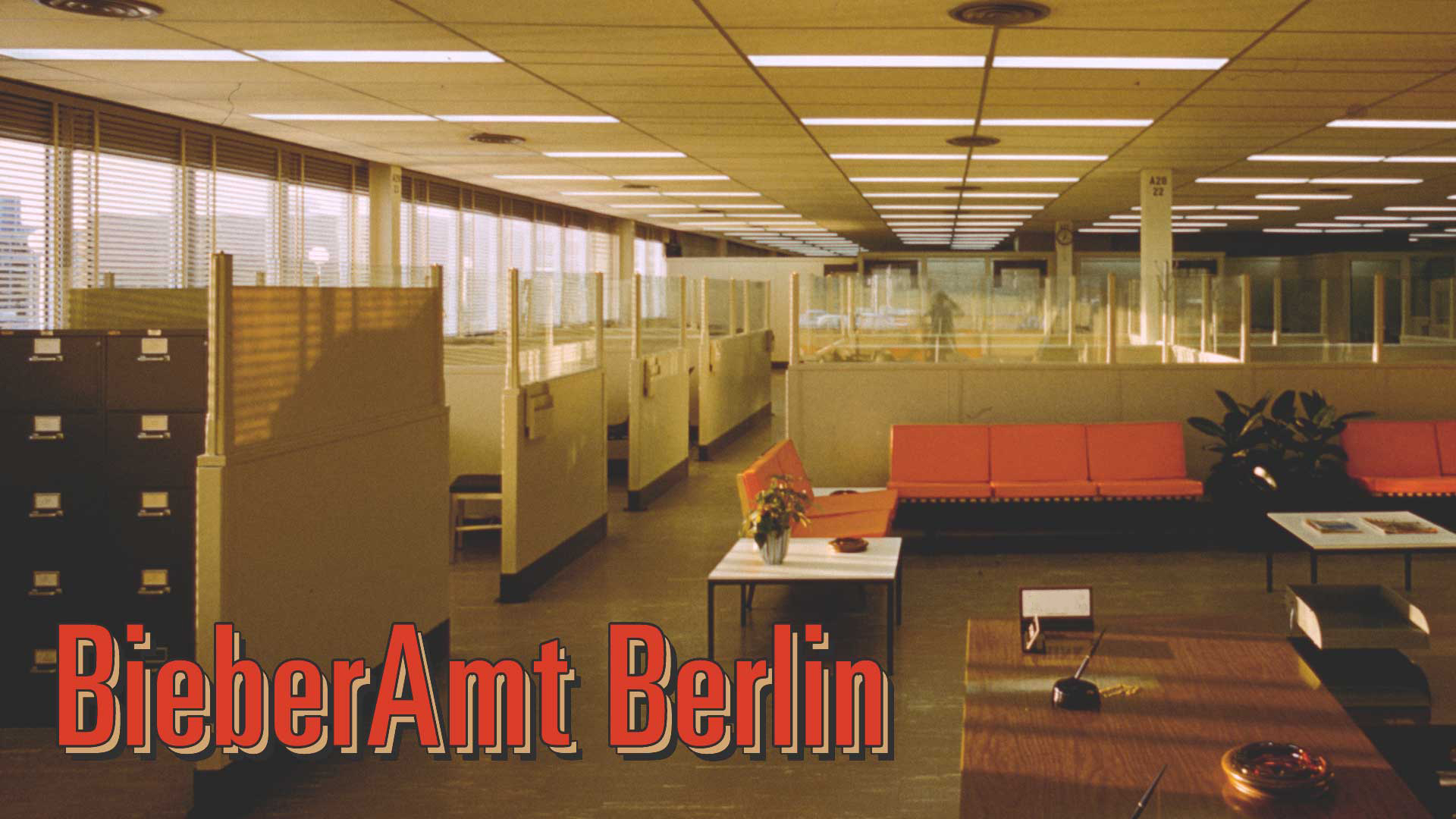
Part workplace, part archive, part art installation, and part public interface, BiberAmt invites visitors to step inside an institution learning to live with more water, more wildlife, and greater ecological complexity.
Situated within Floating University — a former rainwater retention basin turned nature-culture learning site — the project asks how cities might adapt not only through plans and infrastructure, but through new forms of care, responsibility, maintenance, and coexistence. Throughout the opening period, BiberAmt will also convene a series of public agency sessions — The Wet, The Wild, and The Weird — where visitors, researchers, practitioners, and artists come together to explore particular questions emerging from the agency’s ongoing work.
The project is developed by Johannes Stripple and Pauline Münch in collaboration with Floating University Berlin and the design studio Feral Malmö, as part of the Horizon Europe-funded NATURESCAPES project.
Opening Hours
6th–20th August 2026
Wed -Sat 16:00 – 20:00
Sundays 14:00 – 18:00
Come in as a temporary member of staff. Review case files. Sort correspondence. Weigh in on flooded pathways, gnawed trees, habitat conflicts, and unclear responsibilities — or just stop by for a coffee
Public Programming
Opening: Thursday August 6th
BiberAmt opens its doors and invites visitors to come in, take a look at case files on the desk, and consider what it means to work in a changing city.
Workshop – The Wet: Sun Aug 9th
Through discussion and artistic intervention, the agency opens its cases to the public for knowledge exchange and participation. This session turns its attention to water — what retention, flooding, and saturation actually looks and feels like for a Sponge City.
Workshop – The Weird: Thu Aug 13th
Through discussion and artistic intervention, the agency opens its cases to the public for knowledge exchange and participation. This session is set aside for the speculative stories which stretch across geographies, linking the human and more-than-human worlds from Berlin to the UK.
Workshop – The Wild: Sun Aug 16th
Through discussion and artistic intervention, the agency opens its cases to the public for knowledge exchange and participation. This session asks what does it mean to share urban space with beavers and other species reshaping Berlin?
Closing: Thursday August 20th
An institution closes its doors. Part office, part installation, part something harder to name. Step inside and see what is next.

